
Opening Perspectives and the Journey from MEDEZE: A Business Founded by Physicians and Scientists

The Origin of Thailand’s Stem Cell Industry Leader
With the vision of Dr. Veerapol Khemarangsan, Chairman of the Board of Medeze Group Co., Ltd., who serves as the driving force behind MEDEZE, he recognized and witnessed firsthand the potential of stem cells or progenitor cells in disease treatment through his direct professional experience. Dr. Veerapol is a specialist in obstetrics and gynecology, a field directly involved in collecting stem cells from umbilical cord tissue and cord blood at the time of childbirth.
Believing strongly in the therapeutic potential of stem cells to expand treatment options for diseases with limited medical solutions, and at a time when Thailand had only a small number of stem cell banks, most of which were foreign branches that stored only cord blood stem cells, limited to treating blood-related diseases.
This vision led to the establishment of Bangkok Stem Cell Co., Ltd. in 2010. The company was founded in collaboration with the Association. Prof. Dr. Rangsan Palapai, Director of the Embryo and Stem Cell Technology Research Center, Suranaree University of Technology, and President of the Stem Cell Society of Thailand, as well as Dr. Jamras Sakulpaisal, founder of the Assisted Reproductive Technology Center, Maharaj Hospital, Nakhon Ratchasima. As a result, MEDEZE was established from the very beginning through the collaboration of leading physicians and stem cell scientists in Thailand.

Commitment to Becoming a National and Global Leader in the Stem Cell Industry
From its inception, MEDEZE differentiated itself from other stem cell banks in Thailand by becoming the first in the country to store all types of stem cells, including both hematopoietic stem cells and umbilical cord tissue-derived stem cells.
In the following years, MEDEZE further expanded its capabilities by becoming the first stem cell bank in Asia to store adipose (fat) tissue-derived stem cells and the only stem cell bank in Thailand to utilize an automated stem cell separation system (AutoXpress; AXP®)that can reduces human error and improves stem cell tissue quality before cryopreservation, achieving a cell recovery success rate of over 95%, compared to 64–76% with manual separation methods.[1,2]
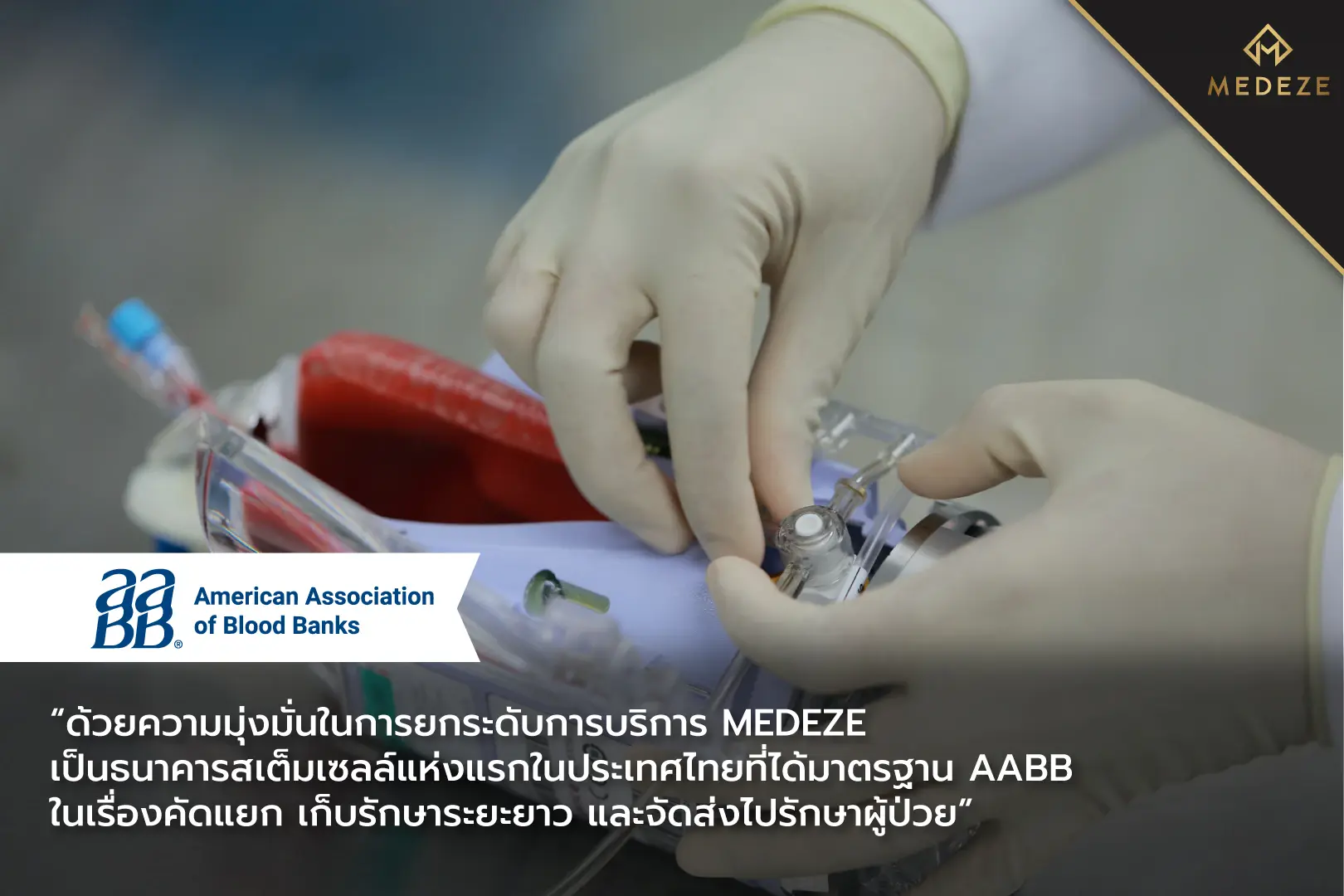
MEDEZE is founded by physicians and scientists who are committed to delivering the highest possible standards to its clients. MEDEZE is accredited for stem cell processing, long-term storage, and transportation for clinical use by the American Association of Blood Banks (AABB), which is one of the world’s most stringent stem cell banking accreditation bodies. Additionally, MEDEZE laboratories meet the National Environmental Balancing Bureau (NEBB) standards for high-quality laboratory environments.
MEDEZE continues to strengthen its leadership by investing in research and development through Medeze Research and Development, focusing on generating new knowledge that can be applied to service innovation and tangible product development. At present, MEDEZE has produced numerous research studies and innovations in collaboration with leading medical institutions across Thailand.
The founding physicians and research teams are dedicated to elevating Thailand’s stem cell industry to global standards, both in manufacturing processes and in research and development that supports the real-world application of stem cells. In the past, public understanding of stem cell use was largely limited to aesthetic applications. However, MEDEZE has expanded stem cell use into broader medical treatments through research and social initiatives conducted by the Medeze Foundation, in accordance with internationally recognized research standards. Examples include applications in patients with hip osteoarthritis and knee osteoarthritis, among others.

MEDEZE is committed to making high-quality stem cell access affordable for Thai people and to becoming a global leader in regenerative medicine services. MEDEZE offers comprehensive stem cell solutions encompassing cell separation, storage, and expansion, in preparation for future clinical applications that deliver the promise of “longer life,” enabling individuals to live fully and happily alongside the people they love.
References
1) Rubinstein P. Cord blood banking for clinical transplantation. Bone marrow transplantation. 2009 Nov;44(10):635-42.
2) Basford C, Forraz N, Habibollah S, Hanger K, McGuckin CP. Umbilical cord blood processing using Prepacyte‐CB increases haematopoietic progenitor cell availability over conventional Hetastarch separation. Cell proliferation. 2009 Dec;42(6):751-61.