
The Growth of the Stem Cell Banking Industry in Thailand and Market Leader MEDEZE Group

The Growth of the Stem Cell Banking Industry in Thailand and Market Leader MEDEZE Group
Stem cells, or progenitor cells, have been recognized in Thailand for some time. Many people are familiar with their use in the treatment of blood-related diseases or through applications in the aesthetic and cosmetic industry. However, advancements in stem cell–based therapies have progressed significantly in recent years, with stem cells increasingly used to treat a wide range of diseases. The global stem cell industry was valued at approximately USD 15 billion in 2020 and is projected to reach USD 26 billion by 2026[1] representing a compound annual growth rate (CAGR) of approximately 8.8–10.2%[1,2] This growth rate is considerably higher than the overall healthcare industry's average of around 5% per year[3]
KEY TAKEAWAY
The global stem cell industry grew from about USD 15 billion in 2020 to a projected USD 26 billion by 2026, a CAGR of 8.8–10.2%, well above the broader healthcare industry average.
Related research surged from roughly 800 studies in 2019 to over 5,000 by 2021, spanning oncology, diabetes, kidney disease, liver disease, and joint degeneration.
Founded in 2010 as Bangkok Stem Cell Co., Ltd., MEDEZE became the first stem cell bank in Thailand and Asia to store adipose-derived stem cells, and the first in the world to offer lifetime storage (now a 60-year guarantee).
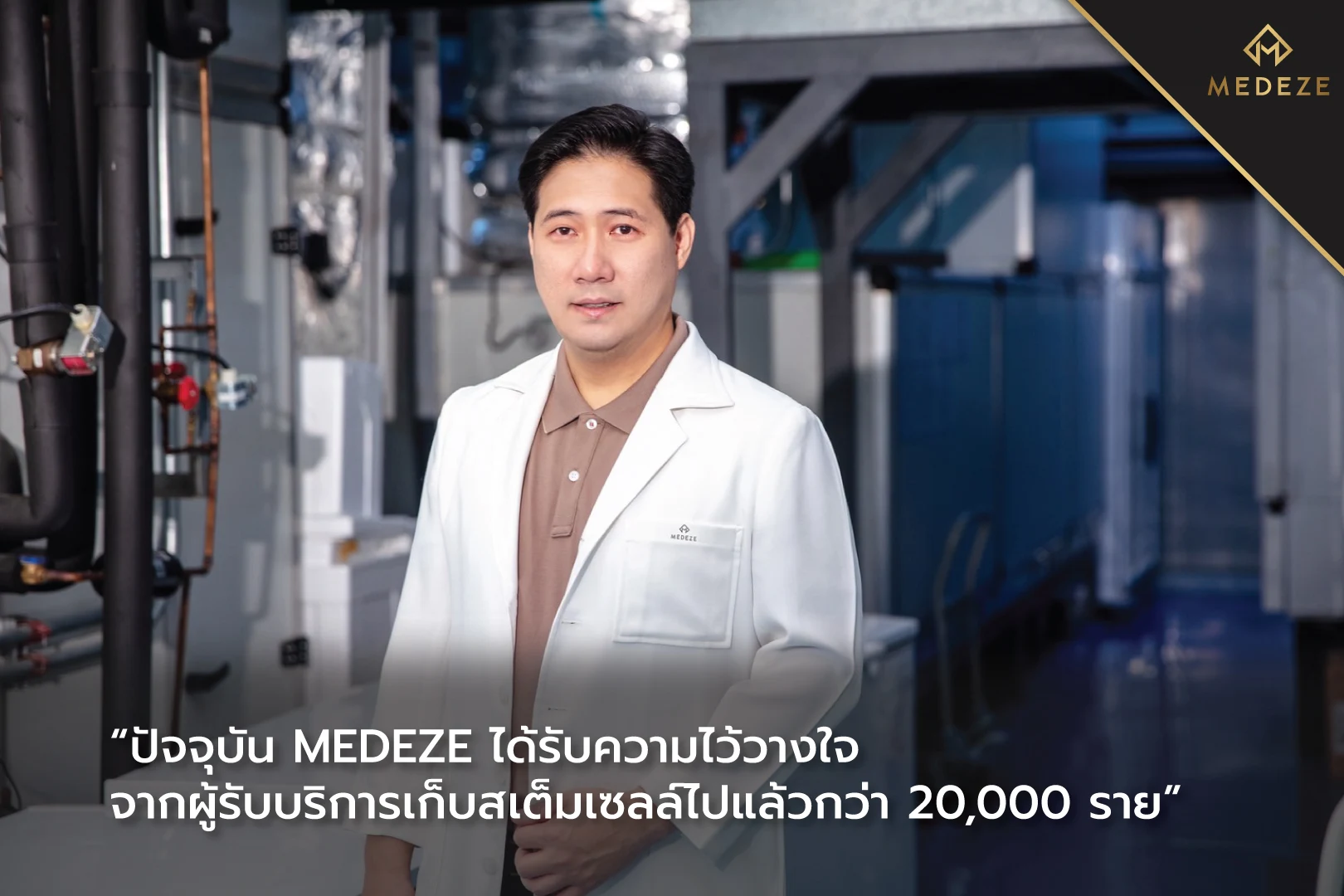
MEDEZE is the only stem cell bank in Thailand using the automated AXP® system, achieving over 95% cell recovery, and has served more than 20,000 clients to date.
MEDEZE aims to become a global leader by 2026 through R&D initiatives including bioengineered corneal substitutes, Osaki Method NK cell therapy, hair follicle stem cell culture, and knee osteoarthritis treatment with Phramongkutklao Hospital.

The expansion of stem cell applications in medicine is evident in the rapid increase in related research activity. In 2019, approximately 800 studies investigating stem cell applications were reported[4] This number rose sharply to around 5,000 studies by 2021[5] These studies span multiple medical fields, including oncology, diabetes, chronic kidney disease, liver cirrhosis, and degenerative joint diseases. This growth aligns with the increasing incidence of cancer, which is currently the second leading cause of death worldwide[1] as well as the COVID-19 pandemic, which accelerated the adoption of emerging medical technologies. Stem cells have demonstrated potential as an alternative therapeutic option for patients infected with COVID-19[6]

The growth of the stem cell industry has been consistent across all stages of the value chain, including cell isolation, storage, and cell culture. Currently, approximately 42% of stem cell usage involves autologous stem cells (stem cells derived from the patient's own body)[2] This proportion is expected to increase, as autologous stem cell therapies reduce the risk of immune rejection. Consequently, demand for stem cell isolation and storage services has also increased, driven by a growing preference for personalized stem cell banking.
Leading the Stem Cell Industry in Thailand
In Thailand, MEDEZE is widely recognized as a leader in the stem cell industry. The company was founded in 2010 under the name Bangkok Stem Cell Co., Ltd., and established a stem cell bank certified by the American Association of Blood Banks (AABB). This certification covers quality standards for isolation, long-term storage, and transportation of stem cells collected from neonatal umbilical cord blood for clinical use.

MEDEZE is also the only stem cell bank in Thailand to utilize the AXP® automated system for hematopoietic stem cell separation. This fully automated system minimizes human error, operates within a closed system to reduce contamination, and better preserves stem cell quality compared with manual separation methods. As a result, MEDEZE achieves a cell recovery rate of over 95%, significantly higher than the 64–76% typically reported for manual processing methods[7,8] The AXP® system is trusted by world-class laboratories, including The New York Blood Center, the largest blood bank in the United States[9]
Furthermore, MEDEZE is the first stem cell bank in Thailand and Asia to store adipose tissue-derived stem cells successfully. Through continuous innovation, MEDEZE has also become the first company in the world to offer lifetime stem cell storage services. In contrast, most providers traditionally offer storage for only 20 years (now adjusted to a 60-year guarantee to align with accounting standards in preparation for future stock market listings). To date, MEDEZE has provided stem cell storage services to more than 20,000 clients.
MEDEZE's Vision to Become a Global Leader in the Stem Cell Industry
MEDEZE is committed to becoming a global leader in the stem cell industry through continuous innovation driven by MEDEZE Research and Development. The company conducts both fundamental research to generate new scientific knowledge that can be translated into advanced services and product innovation research aimed at creating tangible new therapies and service offerings. Currently, MEDEZE is developing Bioengineered corneal substitutes for transplantation (now in the animal testing phase in collaboration with the Faculty of Veterinary Science, Chulalongkorn University), enhanced natural killer (NK) cell therapies designed to target cancer cells precisely, developed in collaboration with Japan using the "Osaki Method", Stem cell–based hair follicle culture services, and, Clinical applications of autologous adipose-derived stem cells for knee osteoarthritis, in collaboration with Phramongkutklao Hospital.
Through continuous development and a strong commitment to making high-quality stem cell services accessible to the Thai population, Dr. Veerapol and MEDEZE Group aim to become a global leader in comprehensive regenerative stem cell services by 2026. This includes end-to-end capabilities for stem cell isolation, storage, and expansion to support future real-world clinical applications. MEDEZE's ultimate mission is to deliver "longevity of life," empowering individuals to live fully, actively, and happily alongside the people they love.
References
1) Mordorintelligence. Global Stem Cell Market Report 2021 - Growth, Trends, COVID-19 Impacts, and Forecasts 2021-2026. [Online]. 2021. Available at: https://www.mordorintelligence.com/industry-reports/stem-cell-research-market. [Sep 2021]
2) Grandviewresearch. Stem Cells Market Size, Share & Trends Analysis Report By Product (Mesenchymal, Adult, iPSCs), By Application, By Technology (Cell Acquisition, Cryopreservation), By Therapy, By Region, And Segment Forecasts, 2021 - 2028. [Online]. 2021. Available at : https://www.grandviewresearch.com/industry-analysis/stem-cells-market. [Sep 2021]
3) Deloitte. 2020 US and global health care outlook. [Online]. 2020. Available at : https://www2.deloitte.com/us/en/pages/life-sciences-and-health-care/articles/global-health-care-sector-outlook.html. [Sep 2021]
4) Sydney Wyatt. Stem Cell Therapy: The Future of Healthcare?. [Online]. 2020. Available at : https://davissciencesays.ucdavis.edu/news/stem-cell-therapy-future-healthcare. [Sep 2021]
5) www.clinicaltrials.gov. [Online]. 2021. Available at : https://www.clinicaltrials.gov/ct2/results?cond=stem+cell&term=&cntry=&state=&city=&dist=. [Sep 2021]
6) Golchin A, Seyedjafari E, Ardeshirylajimi A. Mesenchymal stem cell therapy for COVID-19: present or future. Stem cell reviews and reports. 2020 Jun;16(3):427-33.
7) Rubinstein P. Cord blood banking for clinical transplantation. Bone marrow transplantation. 2009 Nov;44(10):635-42.
8) Basford C, Forraz N, Habibollah S, Hanger K, McGuckin CP. Umbilical cord blood processing using Prepacyte‐CB increases haematopoietic progenitor cell availability over conventional Hetastarch separation. Cell proliferation. 2009 Dec;42(6):751-61.
9) Cord Blood Registry. Cord Blood Registry Achieves Industry-Leading Stem Cell Recovery With New Automation Technology. [Online]. 2007. Available at: https://www.biospace.com/article/releases/-b-cord-blood-registry-b-achieves-industry-leading-stem-cell-recovery-with-new-automation-technology-/. [July 2021]